Email Marketing for Nonprofits: A Strategy That Builds Trust

ÂLI OKUMUŞOĞLU
Nonprofit email marketing works when you treat the inbox as a relationship rather than a collection box. Build a list of people who chose to hear from you. Segment it by what they have actually done. Send far more value than asks. Measure more than donations. The platform you pick matters much less than those four habits.
This guide is for heads of communications, fundraising leads and small teams who need email to carry real weight with limited hours. We cover strategy first, then the practical parts: list health, content rhythm, legal basics, free tools and metrics.
TL;DR
-
Email is among the most cost-efficient channels a nonprofit has, but only when it nurtures supporters instead of just soliciting them.
-
Segmentation beats frequency. Salesforce reports that 60% of supporters feel communications are not personalized to them.
-
A practical rhythm is three emails of stories, impact or education for every one direct appeal.
-
In the US, the CAN-SPAM Act sets hard rules on headers, subject lines, postal address and opt-outs. Other regions, such as the UK, add consent requirements.
-
Track petitions, event sign-ups and shares alongside gifts, and clean out contacts who have gone silent.
Table of Contents
Why email still earns its place
Social platforms change their algorithms, and your reach changes with them. An email list is an audience you hold directly. Industry guidance from Salesforce describes email as a cost-efficient channel that often beats traditional direct mail on speed and gives you real-time data to adjust donor engagement. CharityWise makes a similar point: email is a direct line to supporters, which lets you share stories, raise funds and drive action at scale.
The word to hold on to is nurturing. A donor who only hears from you when you need money learns to expect a request. A donor who also hears what their last gift made possible learns to expect a partner. That difference shows up in retention long before it shows up in any one campaign report.
We see the same pattern across the organizations we work with. The ones with the clearest sense of who they are speaking to, and why, tend to have the healthiest lists. The ones chasing volume tend to have the loudest ones.

Start with a list people chose to join
A large list is not an asset by itself. A small, engaged list outperforms a big, indifferent one, because inbox providers watch how people react to your messages.
Ask clearly, once, at the right moment
The best sign-up moments are the ones where interest is already high: after someone signs a petition, registers for an event, finishes a donation or downloads a report. Say plainly what they will receive and how often. A vague “stay in touch” box invites vague engagement.
Avoid adding people because they once attended an event or appear in a colleague’s spreadsheet. Brevo’s nonprofit guide notes that people who never wanted to hear from you are unlikely to engage and may mark you as spam, which can hurt deliverability.
Keep your data connected
A common pitfall is leaving donor data in a spreadsheet or a separate CRM with no automated link to the email platform. Campaign Monitor’s guide warns that without syncing donation history or event attendance, you lose the ability to send personalized, triggered messages. Supporters then get content that feels irrelevant, and some unsubscribe.
Salesforce also flags data integrity: duplicate records erode trust and reduce engagement. Someone who receives the same appeal twice, or a “become a donor” message after giving last week, notices.
Segment by behavior, not by guesswork
The most persistent myth in this field is that more emails mean more donations. Engagement follows relevance. You do not need sophisticated tooling to start. Four segments cover most organizations:
| Segment | Who they are | What they need from you |
|---|---|---|
| New subscribers | Joined in the last 30 to 60 days | A welcome series that explains your mission and sets expectations |
| Active donors | Gave recently | Thanks, proof of impact, a path to give again |
| Lapsed donors | Gave before, not recently | A reminder of shared history, a low-pressure re-engagement |
| Advocates and volunteers | Signed, shared, attended, but never gave | Actions that match their interest, and eventually a gentle introduction to giving |
The fourth group is the one most often ignored. These supporters already act on your cause. Treating them as failed donors, rather than engaged advocates, wastes some of your best relationships.
A rhythm that protects donors and deliverability
Practitioners often cite a 3:1 rule: for every three emails that deliver impact, stories or educational value, send one direct fundraising appeal. The DMA’s guidance for charities is where we found it described. Think of it as a starting point to test, not a law.
It works for two reasons. Supporters feel respected, and engagement stays high, which protects your sender reputation.
What fills the three
-
A story with a person or place in it. One beneficiary, one project site, one volunteer. Specific beats sweeping.
-
A clear account of results. What changed because of the money, in plain numbers and plain words.
-
Something useful. A short explainer, a how-to, a behind-the-scenes look at a decision your team made.
Writing the appeal itself
When the ask comes, make it short and unambiguous. One call to action, repeated, not five competing ones. Tie it to something supporters have already seen in your earlier emails. If your last three messages built the case, the fourth can be brief.
Subject lines and sender names
Use a real person’s name or your organization’s name consistently, and write subject lines that describe the email honestly. Honesty is a legal point as well as a trust point, as the next section shows.
The legal basics, by region
Compliance is not decoration. It shapes how supporters feel about you, and it protects you from real penalties. Which rules apply depends on where your recipients live, so check before you send.
United States: CAN-SPAM
The FTC’s CAN-SPAM compliance guide covers commercial messages. Its core requirements are accurate header information, subject lines that are not deceptive, a valid physical postal address, and a clear way to opt out. The same guide says opt-out requests must be honored within 10 business days, and it lists penalties of up to $53,088 per violating email as of its August 2023 publication. That figure is adjusted periodically, so check the current amount.
Whether a particular fundraising or advocacy email counts as “commercial” depends on its primary purpose. Do not assume your nonprofit status exempts you. If you are unsure about a specific campaign, ask your legal counsel. Following the rules across the board is simpler than parsing each message.
United Kingdom and EU readers
If you email supporters in the UK, consent rules under UK GDPR and PECR apply. Zeffy’s UK charity guide notes that serious GDPR breaches can bring fines of up to £17.5 million, and that sound consent practices also reduce spam complaints and improve deliverability. If your list spans several countries, build to the strictest standard you face. Record when and how each person consented.
Free and low-cost tools: what to check before you commit
The good news is that you can start cheaply. Eligible nonprofits can use Google for Nonprofits, which offers products and discounts. Its Workspace offer includes custom-domain email. A branded address such as name@yourorganization.org looks more trustworthy than a free webmail address and helps recipients recognize who is writing. Eligibility varies by country and requires verification, so check Google’s feature comparison for nonprofits before you plan around it.
Workspace gives you a professional inbox, not a full newsletter system. For list management, templates, automation and reporting you will need a dedicated email platform. Whatever you choose, test these questions:
-
Does it integrate with your donor database or CRM, or can you automate an import?
-
Can you segment by giving history, event attendance and engagement?
-
Does it handle unsubscribes and consent records automatically?
-
Do the free-tier limits still work when your list doubles?
-
Who on your team will actually build and maintain templates?
That last question is often the real constraint. A cheap tool that nobody has time to use costs more than a better-suited one that fits your workflow.
Keep the list healthy
Deliverability is the quiet threat. Inbox providers penalize senders when many recipients ignore or mark messages as spam. Salesforce notes that practitioners suppress contacts who have not opened an email in six months, which can improve reach because your messages land with the people who want them.
Before removing anyone, run a re-engagement sequence of two or three emails with a plain question: do you still want to hear from us? Those who stay silent can be suppressed rather than deleted, so you keep the history without hurting your reputation.
Other routine hygiene:
-
Remove hard bounces after every send.
-
Make the unsubscribe link easy to find. Hiding it pushes people toward the spam button.
-
Design for phones first, with short paragraphs and a button large enough to tap.
-
Send at a consistent cadence, so supporters know when to expect you.
Measure what the mission actually needs
Donations matter, but they are one outcome among several. The DMA suggests that charities diversify their success metrics to include secondary actions such as petition signatures, event attendance and social shares. That shift turns email from a transaction tool into a relationship tool.
A practical dashboard might include:
-
Click rate by segment, which tells you more than open rate, since opens can be inflated by privacy features in mail apps.
-
Action rate: petitions, registrations, volunteer sign-ups.
-
Donor retention among those who receive your story emails versus those who do not.
-
List growth net of unsubscribes and suppressions.
-
Replies, which are an underrated signal that a real person is reading.
Agree on a baseline and review it quarterly. Compare yourself with your own past results before you compare yourself with sector averages, because audiences, causes and list ages differ too much for averages to mean much.
Our perspective: communicate impact, not just need
We work with NGOs, foundations, EU-funded consortia and mission-driven startups, and the same tension appears again and again. Teams are understaffed, funders want visibility, and email becomes a place to push out whatever is most urgent. The result is a stream of messages that reads like an institution talking to itself.
We think the better question is not “what do we need to send this week?” but “what do our supporters need to understand about the change they are part of?” That is a brand question before it is an email question. If your verbal identity is unclear, no segmentation will rescue the newsletter. If your story about impact is clear, even a modest list can do real work.
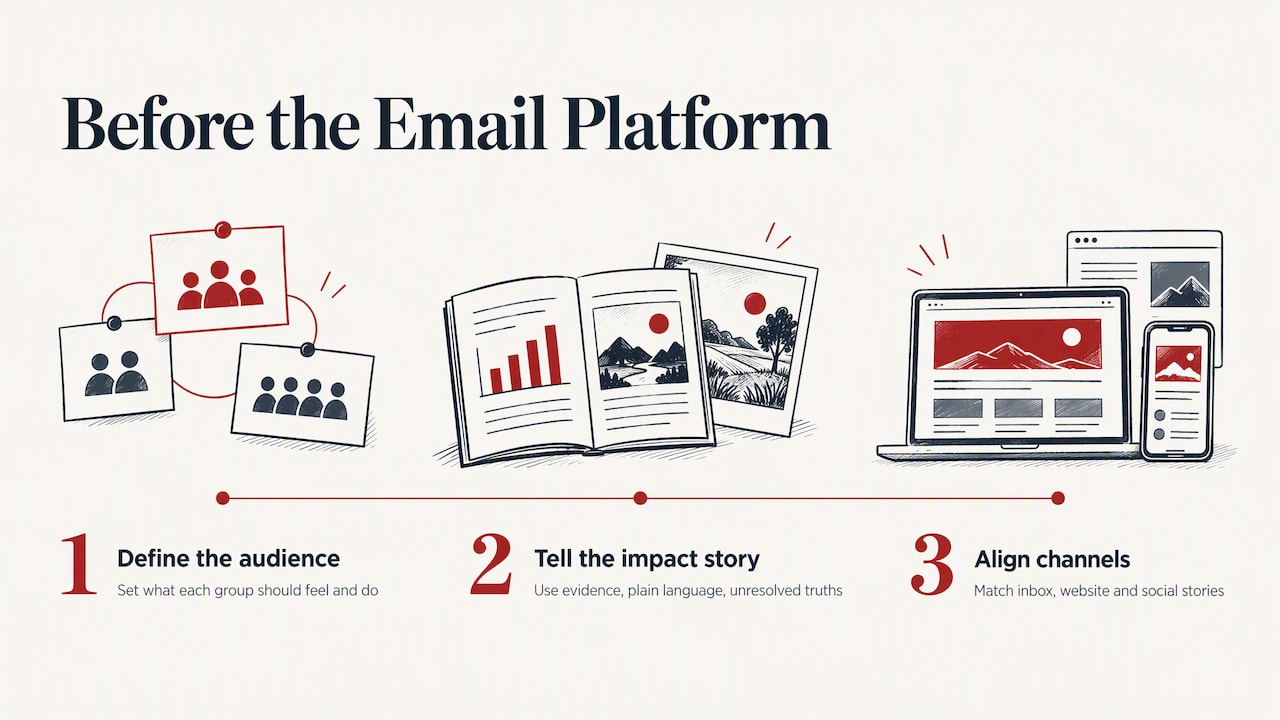
So we encourage organizations to do three things before they open an email platform. First, define who they are speaking to and what each group should feel and do. Second, decide how impact will be told: with evidence, in plain language, and with honesty about what is still unresolved. Third, treat email as one channel in a cross-channel strategy, so the story supporters read in their inbox matches the one on your website and social feeds.
There is also an ethical dimension that is easy to skip. Urgency language, countdown timers and emotive imagery can raise short-term numbers, and they can also wear down trust. We would rather see a mission-led organization grow a smaller list of people who believe it than a larger one that opens out of habit. That is the grey space where good intentions can drift, and it is worth naming in your team before a campaign goes out.
If your communications team is stretched thin, you are not alone. We have written about what to do when you are overwhelmed by campaigns and understaffed in-house, and about the metrics of purpose-driven brands, which pairs well with the measurement advice above.
— Ali
Where we can help
If email is one of several channels you need to coordinate, we can help you build the strategy behind it: audience definition, verbal identity, content planning and reporting. Our services include content creation, social media management and communication consulting, and our impact campaigns work brings those pieces together around a single story. For a sense of how that looks in practice, see how we approached a cross-channel strategy for online storytelling.
FAQ
Can a nonprofit do email marketing for free?
Yes, to a point. Many email platforms offer free tiers with limits on list size or monthly sends, and eligible organizations can get a custom-domain inbox through Google for Nonprofits. The hidden costs are time and data: free setups often lack automated links to your donor records, which limits personalization. Plan for the point at which your list outgrows the free tier.
How often should a nonprofit email its list?
There is no universal number. A steadier rhythm matters more than a high one, and a useful starting rule is three value-led emails for every direct appeal. Watch click rates and unsubscribes by segment, and adjust. If engagement drops after a heavier month, send less and make each message more relevant.
What should a nonprofit put in its email newsletter?
Lead with one story or result, add one useful piece of information, and include one clear action. Keep appeals separate from impact updates where you can. Recipients should finish reading knowing what changed because of their support.
Do nonprofits have to follow CAN-SPAM?
The FTC’s guide applies to commercial email, and the test is the message’s primary purpose, so a fundraising or advocacy email may fall on either side. The safest approach is to follow the requirements for every send: accurate headers, honest subject lines, a postal address and a working opt-out honored within 10 business days. For a specific campaign you are unsure about, ask a lawyer. If you email people in the UK or EU, additional consent rules apply.
Sources
-
Campaign Monitor: Nonprofit Email Marketing, The Ultimate Guide
-
Federal Trade Commission: CAN-SPAM Act Compliance Guide for Business
-
Google for Nonprofits Help: Compare Google Workspace features
Recommended

Let's talk
