Verbal Identity Guidelines: How to Write Ones Your Team Will Use

ÂLI OKUMUŞOĞLU

Verbal identity guidelines are the written rules for how your organization sounds and what it says. They cover your voice, your core messages and the way both flex across channels. Brand voice guidelines are one part of them. A good set lets anyone on your team, or any agency you hire, write in a way that is recognizably yours.
For impact-driven organizations, this matters more than most. You are asking people to trust a cause, fund a project or change a behavior. Words do that work, and inconsistent words quietly undermine it.
TL;DR
- Verbal identity is the verbal counterpart to your visual identity: voice (how you communicate) and messaging (what you say).
- Brand voice guidelines sit inside it. Messaging pillars, naming and editorial style complete the picture.
- Keep it short: three to five traits, side-by-side do’s and don’ts, and examples per channel.
- Test it by having someone outside your team write a draft with it. If they can, it works.
- Review it yearly and whenever your strategy shifts.
Table of Contents
- What verbal identity guidelines actually are
- Why your organization needs them
- What to include
- A quick before and after
- Perspective
- Making the guidelines stick
- Work with a team built for impact
- FAQ
- Ready to give your organization a voice people remember?
- Sources
What verbal identity guidelines actually are
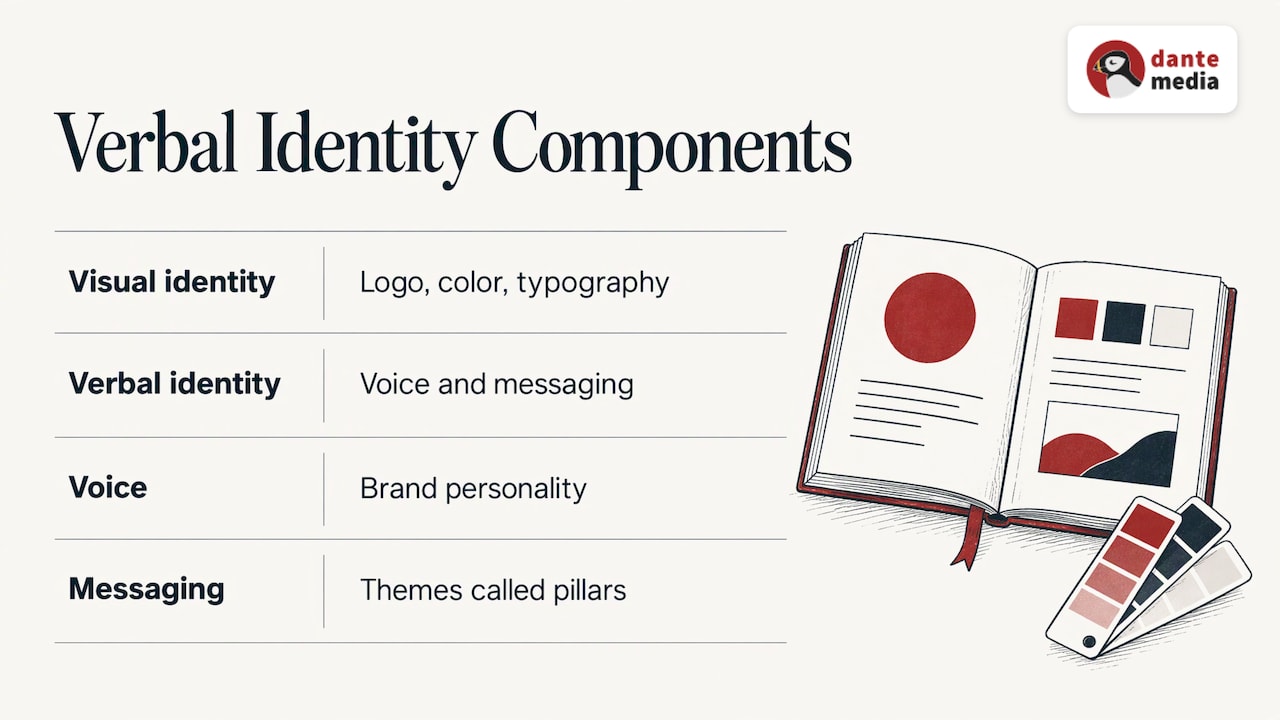
Think of your visual identity: logo, color, typography. Verbal identity does the same job with language. GE HealthCare’s editorial style guide describes it as the complement to visual identity, built on two components: voice and messaging, with the messaging organized into themes called pillars.
That is why “brand voice guidelines” and “verbal identity guidelines” are often used interchangeably, though they are not identical. Voice is the personality. Verbal identity adds the substance: what you want to be known for saying, the vocabulary you own, the terms you avoid and how you handle names, taglines and style.
Why your organization needs them
Consistency builds recognition. The University of Reading’s tone of voice guide puts it plainly: a consistent tone quickly shows readers who you are, what you are like to deal with and what to expect.
For a nonprofit, consortium or startup, the practical reasons are even more concrete:
- Many hands. Program managers, partners, freelancers and agencies all write on your behalf.
- Many audiences. Donors, policymakers, communities and journalists need different things from the same organization.
- Many channels. A grant report and a social post should feel like the same author.
- Speed. Busy teams stop debating adjectives when the answer is written down.
If you want to see how messaging goes wrong without this foundation, our piece on three brand messaging mistakes to avoid is a good companion.
What to include
You do not need a 60-page manual. You need a document people open. A solid set covers these parts.
1. Purpose and narrative
Start with why you exist and the story you tell about it. Grammarly’s guidance on documenting voice lists character, purpose and tone among the essential elements of brand voice. Purpose comes first because everything else follows from it.
2. Voice traits
Choose three to five. Sprinklr describes a brand voice chart as having core traits, do’s and don’ts, and channel applications. Yale’s verbal identity guidelines are a clear example of the trait approach: four attributes, Thoughtful, Energizing, Principled and Uplifting.
Define each trait with what it means in practice, not just the word. “Bold” needs a sentence on what bold sounds like and where it stops.
3. Messaging pillars
Three or four themes you return to everywhere. For each, add the proof points: data, stories, results. This is where impact communication earns its keep, because a pillar without evidence reads as a slogan.
4. Tone by situation
Voice stays constant while tone adapts. RingCentral’s copy style guide frames voice as the personality that does not change and tone as how that personality adjusts to audience and situation. A crisis statement, a fundraising appeal and a product update all deserve different tone settings under one voice.
5. Plain-language rules
Healthwatch England’s tone of voice guidelines advise avoiding jargon where an everyday word exists, explaining unfamiliar terms and using contractions. This is especially useful for science-heavy or policy-heavy organizations explaining complex work to non-experts.
6. Editorial style
Capitalization, numbers, acronyms, inclusive language, spelling variants. Keep it to one or two pages.
7. Channel examples
Show the voice at work: a headline, a social caption, an email opener, a funding announcement. Examples teach faster than adjectives.
A quick before and after
This is an illustration of the method, not a client sample.
| Trait | Don’t | Do |
|---|---|---|
| Direct | “We are leveraging synergies to facilitate outcomes.” | “We bring partners together to get results faster.” |
| Hopeful | “The crisis is hopeless without immediate action.” | “The problem is serious. Here is what is already working.” |
| Inclusive | “Disabled people suffer from barriers.” | “People with disabilities face barriers we can remove.” |
Perspective
We have written and rewritten voice guidelines for organizations that were sure they “just needed a tone of voice”. Almost always, the real gap was upstream: nobody had agreed what the organization stood for in a single sentence.
That is why we start with strategy, then voice, then examples. A verbal identity should make hard decisions easier, such as how to talk about a funder, how to explain a technology, how to stay hopeful without overpromising.
Impact-driven organizations carry a particular responsibility. Our words shape trust in causes that need it. We believe guidelines should be short, human and built with the people who will use them, not handed down as a rulebook.
Ali
Making the guidelines stick
A document nobody uses is decoration. A few habits change that.
Write them the way you want people to write. WVU’s tone and voice playbook tells writers to be people-first, use active voice, choose common words and read the draft aloud. Follow that advice inside the guidelines themselves.
Leave room for judgment. The University of Florida’s voice and tone guidance tells writers to be “consistently inconsistent”, meaning the tips are not rules. Writers choose the language that best carries the message.
Put it where work happens. Link it in your onboarding, your brief templates and your agency kickoff. Apply it to proposals, web copy and support replies alike, as agency profile examples show for professional services.
Separate personality from mood. A consulting team’s character can stay steady while tone adapts to each client conversation, a distinction explored in this look at strategic advisory versus traditional consulting.
Review on a schedule. Check once a year and after any rebrand, merger or new funding stream. Our reflections on how impact became auditable show why language must keep pace with accountability.
Work with a team built for impact
We work exclusively with NGOs, nonprofits, startups, scaleups, public institutions and EU projects. Our Brand for Impact approach connects strategy, verbal identity and design, so your voice is grounded in what you actually do.
If you are also planning campaigns, our impact campaigns put the guidelines to work, and you can see the full range on our services page.
FAQ
What is the difference between verbal identity and brand voice?
Brand voice is the personality of your language. Verbal identity is broader: it combines voice with messaging pillars, naming and editorial style. Voice is how you speak, and messaging is what you say.
How long should verbal identity guidelines be?
Long enough to cover traits, messaging, tone by situation and examples, and short enough that people read them. For most organizations, a handful of pages plus a one-page summary works well.
How many voice traits should we define?
Three to five is a common range, as in the brand voice chart approach. Fewer traits are easier to remember and apply. Add a do and a don’t for each.
Who should write them?
A small group from communications, leadership and program teams, ideally with an outside facilitator who can challenge assumptions. Test the draft with the people who write most often.
Can we use the guidelines with freelancers and agencies?
Yes, and you should. Share them in every brief so external writers match your voice from the first draft. Add real examples so they see the standard.
Ready to give your organization a voice people remember?
Tell us what you stand for, and we will help you say it clearly, consistently and with impact. Start the conversation with Dante.
Sources
- GE HealthCare Editorial Style Guide
- University of Reading, Tone of voice guide
- Sprinklr, Brand Voice Strategy
- Grammarly Business, How to Document Brand Voice Guidelines
- Yale Identity, Verbal Identity Guidelines
- RingCentral, Brand copy style guide
- Healthwatch England, Tone of voice guidelines
- WVU, Tone and Voice Playbook
- University of Florida, Voice and Tone
Recommended


Let's talk
