Brand Messaging Framework: How to Build One That Works

ÂLI OKUMUŞOĞLU
A brand messaging framework is a short, structured document that sets out what your organization says, to whom, and in what order of importance, so everyone who writes for you says the same true thing. It usually runs from one value proposition down through a few pillars, each backed by proof. This guide shows you how to build one, how the hierarchy works, and what it looks like for a mission-driven organization.
TL;DR
- A messaging framework turns your positioning into specific statements for each audience: a value proposition, 4 to 6 pillars, proof points, and voice and tone rules.
- Positioning changes rarely. Messaging gets adjusted as your products, programs and audiences change.
- Build it in this order: audience, positioning, value proposition, pillars, proof, voice. Then test it on real copy before you roll it out.
- For impact organizations, proof points are the weak spot. Evidence, partners and measured outcomes beat adjectives every time.
- The framework only works if it is used: in the website, the grant application, the campaign brief and the onboarding deck.
Table of Contents
- What a brand messaging framework is (and what it is not)
- What to include: the components
- How the messaging hierarchy works
- Build your framework in six steps
- The three C’s of brand messaging
- From framework to daily use
- Common mistakes we see
- Our perspective
- Where we can help
- FAQ
- Sources
What a brand messaging framework is (and what it is not)
Think of it as the shared source of truth for your words. Teams without one tend to end up with a website that says one thing, a funding proposal that says another, and a social feed that improvises. Nobody is wrong. Nobody is aligned either.
The cleanest way to separate the two ideas that get confused: positioning is the concise statement of why you are different, and messaging is the detailed description of what you do to make that statement true. One analogy compares positioning to the behind-the-scenes work on a film and messaging to the finished film, with its features, benefits and proof points. Another way to put it: positioning is the strategic exercise, and messaging is the conduit that carries that strategy into external narratives.
They also age differently. Positioning is revised only rarely, while messaging may be adjusted occasionally as products or audience segments evolve. That is a useful planning rule. Do the positioning work once and carefully. Treat the framework as a living document with a named owner and a yearly review.
A framework is not a tagline, a style guide or a brand story, though it feeds all three. It is the layer underneath them that decides what gets said first, what gets said second, and what never gets said at all.

What to include: the components
Most frameworks share the same parts. Typical components are a brand positioning statement, target audience, value proposition, message pillars, proof points, and voice and tone guidelines. Here is what each one does in practice.
| Component | The question it answers | What good looks like |
|---|---|---|
| Audience | Who are we talking to, and what are they trying to achieve? | One short profile per priority audience, written around their goals, not demographics |
| Positioning statement | Why are we the right choice for them? | One or two sentences, internal use only |
| Value proposition | What do we offer and what changes because of it? | One sentence a stranger understands on first read |
| Message pillars | What are the 4 to 6 big ideas that support the value proposition? | Each pillar is a claim, not a topic |
| Proof points | Why should anyone believe each pillar? | Data, case results, partners, certifications, named programs |
| Voice and tone | How do we sound, and how does that flex? | Principles with before-and-after examples |
The common mistake is to skip proof points because the pillars feel persuasive on their own. They are not. A pillar without proof is a slogan.
How the messaging hierarchy works
The hierarchy is top-down, and the order is the whole point. One official example is New Zealand Trade and Enterprise’s messaging framework template. It leads with a value proposition, supports it with 4 to 6 pillars, backs each pillar with proof points, and then reassesses and ranks the pillars so the strongest customer-relevant messages get priority.
In plain terms:
- Level one, the value proposition. The single umbrella message. Everything below must ladder up to it.
- Level two, the pillars. The few ideas that make level one believable. If you have eight, you have not chosen yet.
- Level three, the proof. Facts, figures, stories and endorsements that make each pillar credible.
- The ranking. Not every pillar matters equally to every audience. A funder, a beneficiary and a policymaker will each care most about a different one. Ranking decides which pillar leads in which context.
That ranking step is where frameworks stop being theory. It is also where most teams get uncomfortable, because choosing a lead pillar means not leading with the others.
A worked example for a mission-driven organization
The example below is illustrative, not a real client. Imagine a nonprofit that restores degraded wetlands with local farming communities.
- Value proposition: We restore wetlands in partnership with the farmers who live beside them, so nature recovers and livelihoods hold.
- Pillar 1, Local partnership. Proof: how many farming cooperatives co-design each site, and what role they hold in governance.
- Pillar 2, Measured recovery. Proof: baseline and follow-up monitoring data, published method, independent verification where it exists.
- Pillar 3, Durable livelihoods. Proof: income or yield changes reported by participating farmers, with the sample size stated.
- Pillar 4, Open reporting. Proof: a public annual impact report and a clear account of what did not work.
Now the ranking. For a government funder, Pillar 2 leads. For a corporate donor, Pillar 3 may lead. For a farmer, Pillar 1 leads and the rest follow. The framework stays the same. The emphasis moves.
Build your framework in six steps
Asana’s approach is to define positioning, analyze competitors, develop voice and tone, create a style guide, talk to customers and evaluate the messaging. That is a solid skeleton. We would reorder it slightly for impact organizations, where the audience is rarely one person.
Step 1: Map your audiences and what they are trying to do
Start with people, not with your own mission statement. Ampere’s 2026 guide recommends grounding the framework in audience context, the progress each audience wants to make, and the alternatives they have, including doing nothing. For a nonprofit, “doing nothing” is a real competitor: a donor who does not give, a policymaker who does not act, a partner who does not reply.
Write one short profile per priority audience. Two or three is usually enough. If you have ten, your messaging will be about everyone and heard by no one.
Step 2: Sharpen your positioning
Write one or two sentences on why you are the right choice for these audiences, compared with what they could do instead. Keep it internal. It is a decision tool, not copy. If your positioning could describe any organization in your field, it is not finished.
Step 3: Write the value proposition
One sentence. What you do, for whom, and what changes. Read it aloud to someone outside your sector. If they need a follow-up question to understand it, rewrite it. This matters even more for complex science: agri-food, biotech and climate work all carry vocabulary that loses non-experts in the first clause.
Step 4: Choose 4 to 6 pillars and attach proof
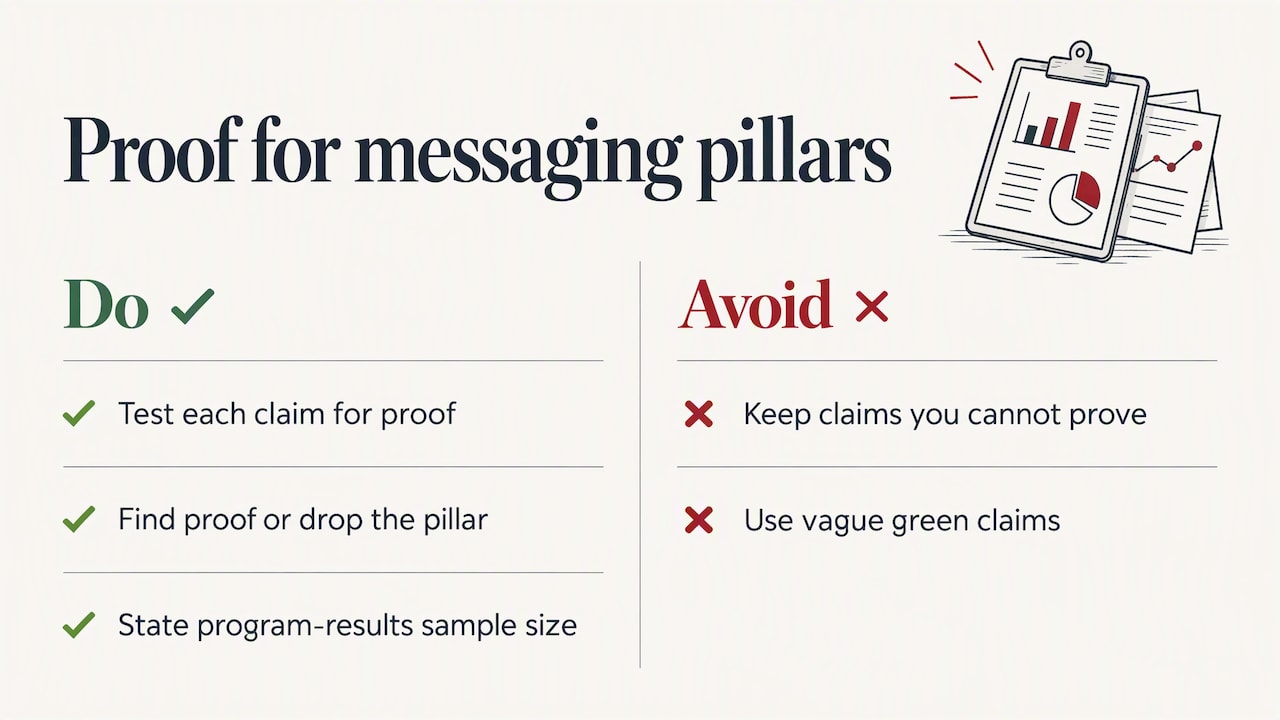
Turn your strongest ideas into claims, then test each one: can we prove this in a sentence, with a number, a name or a source? If not, either find the proof or drop the pillar. Proof for impact work comes from monitoring data, third-party evaluations, named partners, program results with the sample size stated, and honest accounts of limits.
The claims need care. Regulation is tightening around environmental language in Europe, so vague green claims are now a business risk as well as a credibility one. We looked at this in our case study on how the ECGT changes how we speak about sustainability.
Step 5: Define voice and tone
Voice is who you are on the page. Tone is how that voice adjusts to the moment. Messaging should be personalized, with voice and tone shifting by context and audience: a grant report and a social post should sound like the same organization, not the same document.
Write three or four voice principles, each with a “we say this, not that” pair. Looking at how other brands do this helps; a collection of brand voice examples shows how the same personality can be dialed up or down depending on the channel and audience.
Step 6: Test it on real copy
Before you publish the framework, test it. Ampere’s validation process checks messages with the intended audience for comprehension, relevance, credibility and differentiation, using realistic material such as homepage copy, outreach emails, sales slides or ads. For a nonprofit, swap in a donor email, a call for partners or a grant summary. Five honest conversations will tell you more than a month of internal debate.
The three C’s of brand messaging
Searchers often ask about the “three C’s.” There is no single official version. One widely read take names consistency, clarity and character, and it is a handy checklist for any draft.
- Consistency: the same core message across website, packaging, advertising and every other touchpoint.
- Clarity: a reader understands what you do and why it matters without effort.
- Character: it sounds like you and could not be pasted onto a competitor’s page.
Other writers use different C’s, such as compelling or credible. Pick the set that helps your team edit, and use it as a final filter on every piece of copy.
From framework to daily use
A framework that lives in a shared drive does nothing. These habits move it into the work:
- Put it in every brief. Campaign, website, event, press release: each brief names the audience, the lead pillar and the proof to use.
- Give it an owner. One person, usually the head of communications, approves changes and runs the yearly review.
- Onboard with it. New hires, board members, consortium partners and freelancers should receive it in week one.
- Adapt emphasis, not substance. Change which pillar leads for each audience. Never change what you claim.
- Review when something real changes. A new program, a new funder, a merger or an evaluation result is a reason. A bad week on social media is not.
If you manage a consortium or an EU-funded project, add one more rule: partners must be able to apply the framework without asking you. That means plain language, concrete examples and a one-page summary.
Common mistakes we see
We have written before about three mistakes to avoid with your brand messaging. In framework work, these come up most:
- Too many pillars. If everything is a priority, nothing is.
- Pillars that are topics. “Sustainability” is a topic. “We cut packaging waste by sourcing locally” is a claim.
- Adjectives instead of evidence. Innovative, impactful and passionate say nothing a reader can check.
- Writing for the board. The framework must serve the audience’s needs first, and the internal org chart second.
- No ranking. Without it, every channel leads with whatever the writer likes best.
Impact language is also under more scrutiny than before. As our piece on when impact became auditable argues, branding for organizations with a mission has to be able to stand up to questions.
Our perspective
Most of the frameworks we are asked to fix were not wrong. They were unfinished. They had a value proposition and a list of pillars, and nothing underneath that a funder or a skeptical journalist could check.
We build strategy first, then words, then design, because impact organizations rarely get a second chance at a first impression with a funder, a ministry or a community. A framework gives your team the clarity to move fast without improvising the story each time.
Our advice is simple. Choose fewer pillars than feels comfortable. Rank them for each audience. Hold every claim to the standard of proof you would want if you were the one being asked for money. Then use the framework daily, in briefs, in tenders, in campaigns, until it feels like how you speak.
The organizations that do this well are not the loudest. They are the ones people can repeat accurately after one conversation.
Ali
Where we can help
We are Dante Media, a brand and communication consultancy for organizations creating positive impact: NGOs, foundations, EU-funded projects and consortia, intergovernmental bodies, and mission-driven startups and scaleups. If you want a messaging framework built with your team, from audience mapping and positioning to pillars, proof and voice, our Brand for Impact work is where it starts.
For campaign work that applies the framework across channels, see our impact campaigns. To see how this plays out in practice, read how we helped turn complexity into a competitive edge, or browse all our services.
FAQ
What is the difference between a brand messaging framework and a brand messaging guide?
In most teams the terms overlap. The framework is the structure: value proposition, pillars, proof and voice. A guide usually adds usage detail, such as examples, templates and do and don’t lists for writers. Build the framework first, then expand it into a guide your wider team can use.
How many pillars should a messaging framework have?
Aim for four to six, which is the range used in New Zealand Trade and Enterprise’s template. Fewer is fine if each one carries real proof. If you cannot back a pillar with evidence, drop it or merge it into a stronger one.
How often should we update our messaging?
Review it yearly and whenever something material changes, such as a new program, funder or audience. Positioning should stay stable, and messaging may be adjusted occasionally as products or segments evolve. Change emphasis before you change substance.
Can a small team or a startup use a framework this detailed?
Yes. Start with one page: the audience, one value proposition, three pillars and one proof point for each. You can add voice rules and audience-specific rankings as you grow. A short framework that people use beats a long one nobody opens.
Sources
- Nail Your Brand Positioning and Messaging
- What is brand messaging? A framework for teams of any size
- Stand out or blend in: Founders’ guide to positioning and messaging
- Messaging framework template, New Zealand Trade and Enterprise
- Brand Messaging Framework: Components + 6-Step Guide
- How to create a brand messaging framework
- The 3 Cs of brand messaging
- 19 Brand Voice Examples Every Marketer Should Study
Recommended


Let's talk
