Nonprofit Press Release: How to Write One Journalists Use

ÂLI OKUMUŞOĞLU
A nonprofit press release is a short, formal announcement of real news, written so a journalist can turn it into a story without calling you first. It works when the news is genuine, the first paragraph answers who, what, where, when and why, and a named person says something worth quoting. Everything below shows you how to get there, with a template at the end of the writing section.
TL;DR
- Send a release only for real news: a grant, partnership, results, a public event or a major organizational change.
- Lead with the news and its effect on people, then add detail in decreasing order of importance (the inverted pyramid).
- Include a headline, dateline, lead, body, quote, boilerplate and contact details, and keep it to one or two pages.
- Email it in the body of the message, to the right reporters, midweek and early in the morning.
- If it reads like an ad, editors will ignore it. Write it like a news story.
Table of Contents
- When a press release is the right tool
- What makes your news newsworthy
- What to include in a nonprofit press release
- How to write it so the impact is clear
- Distribution and pitching
- Mistakes that get releases deleted
- Turn one release into a communication engine
- FAQ
- Sources
When a press release is the right tool
The National Endowment for the Humanities describes a press release as a formal announcement of something newsworthy, aimed at journalists and the wider press. It suggests one for major news, such as a grant, a partnership, project results, or information too detailed for a short pitch.
The Community Tool Box adds a practical list: upcoming public events, reports on recent events, organizational changes, awards, grants and publications, new hires or promotions, volunteer recruitment, and the start of a new season of classes or services.
That list is a good filter. If your announcement fits none of it, a social post, a newsletter item or a personal pitch to one reporter will probably serve you better.
What makes your news newsworthy
Newsworthiness is not about how much your team cares. According to the Community Tool Box, it depends on the outlet, audience, location, timing and subject. Typical news values include timely developments, new evidence, local relevance, public accountability, meaningful milestones and significant human experiences.
PRSA guidance names a similar set: timeliness, impact, human interest, novelty or conflict. It also notes that headlines with specific numbers can perform better.
Try this test before you write a word: “Why would a stranger in our region care this week?” If you can answer in one sentence, you have your angle. If you can’t, keep working on the story, not the wording.
What to include in a nonprofit press release
The NEH toolkit lists the standard parts: headline, sub-headline, dateline, lead, body, quotes, boilerplate and contact information. Here is what each one needs to do.
| Part | What it does | What to watch for |
|---|---|---|
| Headline | States the news in one line | Specific, active, no slogans |
| Sub-headline | Adds the key detail or number | Optional, one line |
| Dateline | City, state and date | Matches the news, not your office habits |
| Lead | Answers who, what, where, when, why | One to two sentences |
| Body | Supporting facts, in decreasing importance | Short paragraphs |
| Quote | A named spokesperson gives meaning | Says something a person would say |
| Boilerplate | Who you are, in a few lines | Same wording across releases |
| Contact | Name, email, phone | Someone who will answer today |
The National Sexual Violence Resource Center recommends strong quotes, usually from a leader, and treats quotes, statistics and images as tools that help reporters bring a story to life. The Gates Foundation’s grantee guide adds two habits worth copying: include human interest through stories or quotes from people you have served, and verify every date, time, statistic and name before sending.
How to write it so the impact is clear
Lead with the effect, not the organization
The Gates guide advises framing the lead around how a grant will affect or increase services. Compare two openings:
- Weak: “Green Rivers Alliance is proud to announce a new partnership with a regional foundation.”
- Stronger: “Twelve river towns will get free water-quality testing this spring through a new partnership between Green Rivers Alliance and a regional foundation.”
The second one names the people who benefit and says what changes for them. That is the gap between an announcement and a story.
Write in an inverted pyramid
Several sources agree on this structure. MediaTrust explains that editors cut from the bottom up when space is tight, so the gist and the most newsworthy content go first. ACEP describes the same pattern: a headline and strong lead, then supporting facts in decreasing significance. The Gates guide recommends keeping the release to one or two pages.
Keep the language plain
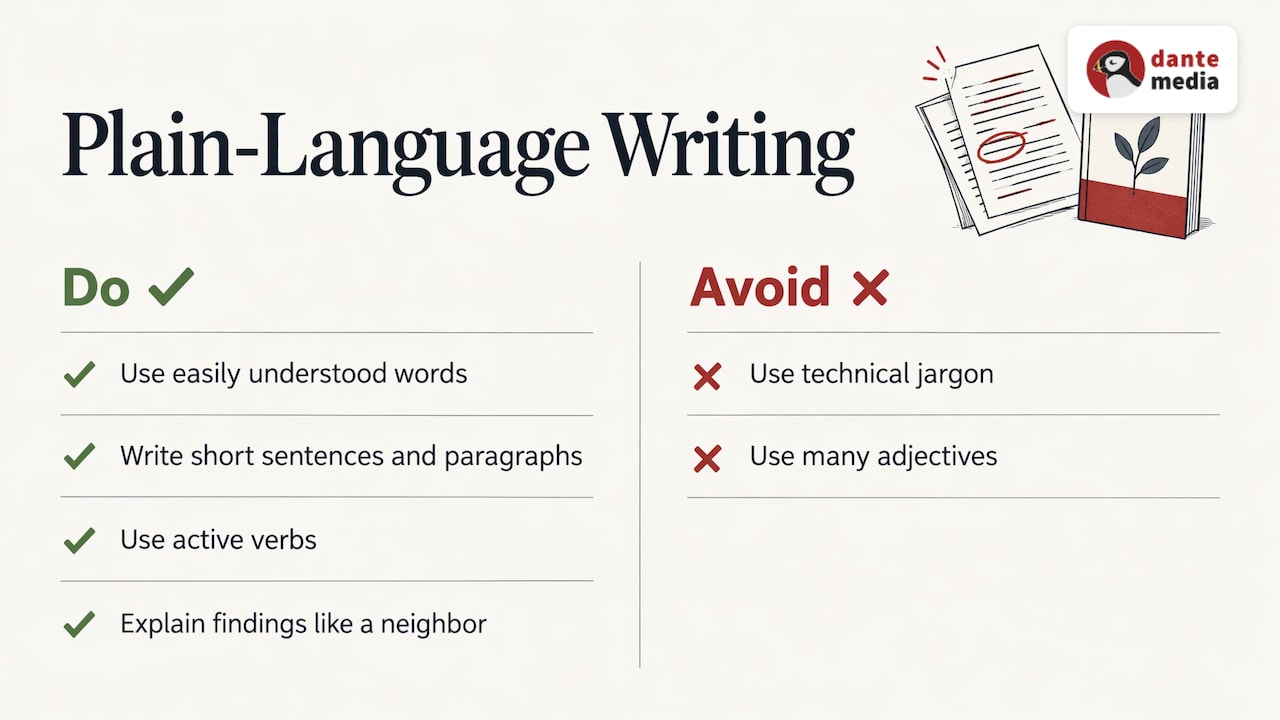
The American Council of the Blind handbook recommends easily understood words, short sentences and paragraphs, and few adjectives. The Gates guide says to use active verbs and avoid technical jargon. If you work in science, policy or climate, this is where the translation happens: explain the finding the way you would to a neighbor.
Short, scannable writing also helps once the release leaves your inbox and travels through email and social channels. If you plan to push the same news through several channels, read about combining email with social media so each version stays consistent.
A template you can adapt
FOR IMMEDIATE RELEASE
Contact: [Name], [Title], [email], [phone]

[HEADLINE: the news, in active voice, with a number if you have one]
[Sub-headline: one line with the key detail]

[CITY, STATE] ([Month Day, Year]) – [Lead: who did what, where, when, and why it matters to people.]

[Second paragraph: the most important supporting fact or figure.]

"[Quote that explains why this matters,]" said [Name, Title]. "[One concrete sentence about the people affected.]"

[Further detail: how to take part, dates, links, background.]

About [Organization]
[Two to three sentences: mission, who you serve, where you work, website.]

###
The three hash marks at the end are a long-standing convention that signals the release is complete. Swap in your own details and cut anything that does not pass the “stranger test” above.
Distribution and pitching
The NSVRC toolkit recommends a plan tailored to your message, audience and goal: target relevant journalists and outlets, email the release, post it on your website and social media, send an email blast, and consider a national wire if you need broader reach. PRSA similarly advises layering personalized pitches for niche stories with newswire services for reach.
A few practical rules from the guides:
- Put it in the email body. The CIVICUS media handbook says to paste the release into the message rather than attach it, and to treat the subject line as important. Mention available case studies, spokespeople and photos.
- Check the calendar. CIVICUS suggests avoiding conflicts such as elections, and sending at least a week ahead with an embargo when the story allows it.
- Time it. PRSA’s media alert guidance says pickup chances rise when alerts arrive between 5 a.m. and 8 a.m. on Tuesday, Wednesday or Thursday, before editorial meetings.
- Follow up once. CIVICUS recommends a follow-up the day before an event. For other releases, the PRSA guide indicates a follow-up after about a week is acceptable.
- Mind the event window. The Gates guide suggests sending event information no more than two weeks and no less than two or three days beforehand.
Post the release on your own site, too, and keep it archived. It becomes a reference for reporters who find you later.
Mistakes that get releases deleted
The biggest one is promotion. The ACB handbook warns that a release that looks like a “glorified ad” may be ignored or rejected. Other common errors:
- Burying the news in the third paragraph, under your history.
- Writing for funders instead of for readers of the outlet.
- Sending the same text to every newsroom without a local or topical hook.
- Quotes that praise the organization rather than explain the issue.
- Unverified numbers, or a contact who is unreachable.
Our perspective: a release is a story, not a statement
We work only with organizations creating positive impact, and we see the same pattern again and again. The work is strong, the people are committed, and the release still reads like an internal memo. The fix is rarely more polish. It is a clearer answer to one question: what changed for whom?
We believe press releases are one instrument in a wider communication strategy, not a stand-alone task. The strongest ones sit alongside a campaign, a brand voice people recognize and content that carries the story further after the journalist has moved on. That is how impact becomes visible, and how it stays visible.
So treat every release as a chance to translate complexity into something a busy person can act on. It is a skill any team can build, and the sooner you build it, the sooner your work travels beyond your own network.
Ali
Turn one release into a communication engine
A good release is a beginning. We help NGOs, EU-funded projects, foundations and mission-driven startups build the strategy, messaging and content around announcements like these, from impact campaigns to the full range of services we offer.
If you want to see how we think about the role of agencies in doing good, our piece on the role of agencies in doing good is a place to start. When you are ready to talk about your next announcement, start at dante.media.
FAQ
How long should a nonprofit press release be?
One page is a strong target, and two is the ceiling. Indivisible describes a release as no longer than one page, and the Gates guide allows one or two. Put the essentials first so that any cut at the bottom costs you little.
Do we need a wire service?
Not always. The NSVRC toolkit lists a national wire as an option, after targeted emails to relevant journalists and posting on your own channels. For local or niche stories, personal pitches usually come first.
What belongs in the boilerplate?
A short paragraph at the end that explains who you are, as the Gates guide recommends. Include your mission, who you serve, where you work and your website, and keep the wording consistent from release to release.
When should we send it?
For events, aim for between two weeks and two or three days ahead. For timing within the week, PRSA’s guidance points to early morning on Tuesday, Wednesday or Thursday.
Sources
- NEH: Press & Traditional Media toolkit
- Community Tool Box: Preparing Press Releases
- Community Tool Box: Creating News Stories the Media Wants
- PRSA: How to Write a Press Release That Actually Gets Published
- NSVRC: Media relations toolkit
- Gates Foundation: Grantee Communication Guide
- MediaTrust: Writing a press release and pitching it to the media
- ACEP: How To Write a Press Release
- American Council of the Blind: The Press Release Handbook
- CIVICUS: Connecting with Media
- PRSA: Creating Effective Media Alerts
- Indivisible: Press Releases, Media Advisories, and More
- Combining email marketing with social media
Recommended

Let's talk
