Event Communications Plan: A Practical Guide for Impact Teams

ÂLI OKUMUŞOĞLU

An event communications plan is the document that decides who hears what, from whom, through which channel and when, before, during and after your event. A good one starts with a measurable objective, maps every audience to a message, assigns one owner to each, and ends with a review against the numbers you set at the start. The same logic holds for a two-day conference, a consortium summit or a one-evening launch. Below is the version we use and recommend, built for busy communication leads who need clarity rather than another template to fill in.
TL;DR
- Write the objective first. Everything else in the plan, from channels to budget, follows from who needs to be in the room and what you want them to do next.
- Build a message matrix: every message gets an audience, an owner, a channel, a send date and a purpose.
- Plan three phases, not one. Anticipation before, engagement during, and follow-up after are where most of the value of an event is either captured or lost.
- Name one accountable owner for the whole plan, and one owner for each audience.
- Choose a handful of metrics tied to your objective, and review them in a meeting that is already in the diary.
Table of Contents
- What an event communications plan is for
- Start with objectives and audiences
- Build the message matrix
- Choose channels that fit each audience
- Schedule communications before, during and after
- Assign owners and run the plan
- Measure what the event was for
- Our perspective
- Where Dante can help
- FAQ
- Sources
What an event communications plan is for
Most teams treat event communication as a countdown of save-the-date emails. That works until the programme changes, a speaker drops out or a funder asks what the event actually achieved. A plan is what lets you answer all three calmly.
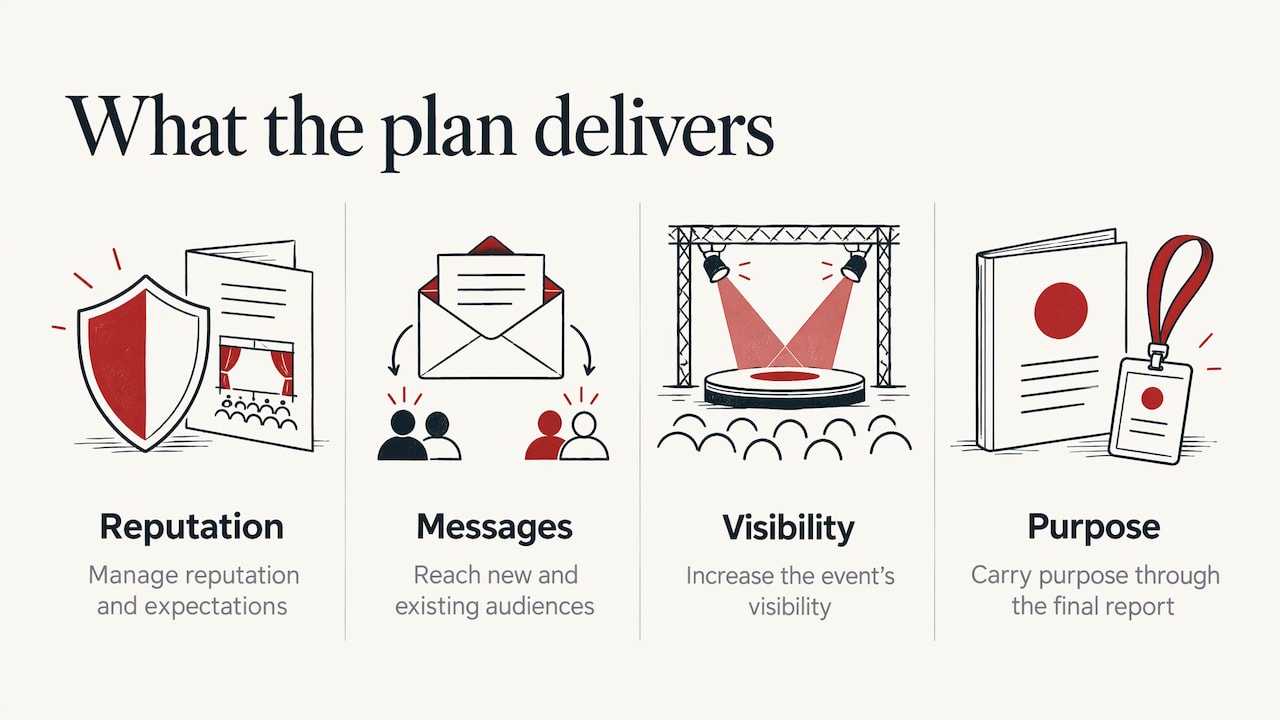
VisitScotland’s guidance for event organisers describes an event communications plan as strategically planned content that supports overall goals, and it structures the work around objectives, audience, strategy, implementation and scoring. According to VisitScotland’s events marketing and communications advice, a plan of this kind can manage reputation and expectations before, during and after an event, deliver key messages to new and existing audiences, and increase the event’s visibility.
For the organizations we work with, such as NGOs, EU-funded consortia, foundations and mission-driven scaleups, there is a further job. The event is rarely the end product. It is the moment where a policy position, a funding story or a new product gets tested in public. The plan has to carry that purpose from the first announcement to the final report.
Start with objectives and audiences
If you do only one thing properly, do this. Before you open a template, answer two questions: what must this event achieve, and who needs to be there for that to happen?
Write objectives you can score
The University of Oxford’s communications team advises that each event should have at least one SMART objective (specific, measurable, accurate, relevant and timely), and that success is judged against those objectives at a post-event evaluation meeting, as set out in its event objectives guidance. The same page suggests defining audience objectives by asking who needs to attend for the event to be a success.
Translated into the work we see most often, the difference looks like this:
- Weak: “Raise awareness of our new restoration programme.”
- Sharper: “Bring 150 municipal and funder representatives to the launch, and secure at least 20 follow-up meetings within a month.”
The second version tells you whom to invite, what the registration page must ask, what the follow-up email should offer and what you will report back. The numbers are examples; yours should come from your own capacity and history.
Segment before you write a word
A conference rarely has one audience. A typical list looks like this:
- Registered attendees, who need practical information and a reason to turn up
- Speakers and moderators, who need briefings and deadlines
- Sponsors, funders and partners, who need visibility and proof of reach
- Press and influencers, who need a story angle and access
- Internal teams and colleagues, who need to know what is happening and how to amplify it
- People who did not register, who may still be reached by recordings and highlights
Guidance on attendee communication from an event-technology publisher makes a point we agree with: segment messages by attendee status and role rather than sending everything to the whole database, and keep the event website as the durable source for programme, venue, travel, accessibility, contact and FAQ details. You can read that in its attendee communication guide. A sponsor does not need the lunch instructions, and a delegate does not need the exhibitor load-in schedule.
Build the message matrix
The core of the plan is a matrix. Every message you intend to send gets a row, and every row answers five questions: who receives it, who owns it, which channel carries it, when it goes out and what it must achieve. If a message cannot answer the last question, cut it.
Here is a trimmed example for a policy conference:
| Message | Audience | Owner | Channel | Timing | Purpose |
|---|---|---|---|---|---|
| Announcement and registration link | Target stakeholders, past attendees | Communications lead | Email, LinkedIn | At announcement | Registrations |
| Speaker announcement | Registrants, wider network | Content manager | Social, website | Weeks before | Sustain interest |
| Speaker briefing | Speakers, moderators | Programme manager | Email, call | Weeks before | Prepared speakers |
| Practical information | Registrants | Event manager | Email, event website | Days before | Smooth arrival |
| Live updates | Attendees, online followers | Social media lead | Social, event app | During | Engagement |
| Thank-you and highlights | Attendees, speakers, sponsors | Communications lead | Within 1 to 2 days after | Relationships | |
| Recording and survey | Registrants, no-shows | Content manager | Email, website | Within the first week | Reach and feedback |
Two habits keep a matrix honest. First, name one person accountable for the whole plan, plus one owner for each audience, so nothing sits between two people’s job descriptions. Second, add an inventory of all digital and print content you need to produce, which is also a recommendation in VisitScotland’s guidance, alongside an overview of the marketing opportunities open to you: website, email, social media, PR, paid promotion and partnerships.
Choose channels that fit each audience
Channels should follow audiences, not habit. A few principles we apply:
- Own your source of truth. One event page holds the programme, speakers, venue, access information and contact details. Every email and post points back to it, so a change is made once.
- Use email for decisions and social for momentum. Registration, logistics and briefings belong in email. Speaker reveals, behind-the-scenes content and live moments belong in social channels.
- Use partners as channels. Co-organizers, funders, speakers and sponsors often reach people you cannot. Give them ready-to-share copy, images and a tracked link, so sharing takes them two minutes.
- Use paid selectively. Paid social or search earns its place when you need to reach an audience beyond your lists, or when registrations lag behind plan at the midpoint.
- Plan accessibility as a channel decision. Captions, plain language, alt text and clear access information are part of reaching people, not a final check.
If you want a wider view of how messaging changes as someone moves from first awareness to long-term loyalty, this customer lifecycle campaign template is a useful frame for deciding which promotion opportunities deserve effort at each stage.
Schedule communications before, during and after
The most common structure is three phases. VisitScotland frames them simply: before the event, build anticipation and plan around key milestones; during it, focus on engagement and capture key moments; afterward, continue engagement with thank-you messages, highlights, a next-event announcement or a survey (source). Here is how we turn that into a working calendar.

Before: build the case for attending
Finish the plan before the public announcement. In our experience, about twelve weeks of runway before announcing suits a mid-sized conference; smaller events can compress, while multi-country ones usually need more. Work backward from the event date and mark the milestones that matter: announcement, first speakers, early registration close, full programme, final logistics.
The pre-event phase usually covers:
- Announcement and registration. A clear value statement for each audience, one primary call to action and the event page live.
- Speaker and programme reveals. Share names, talk titles, photos and short bios in stages, so each reveal is a reason to post and email again.
- Speaker and partner briefings. Timings, formats, Q&A rules, tech checks and the amplification kit.
- Reminder sequence. Segment by status. Registered people get logistics, unregistered people get a reason, and a last-call message goes only to those who showed interest.
- Check your calendar. Look at your own organization’s sends in the same weeks so that one event does not compete with another for the same segment.
During: keep people oriented and capture the story
Live communication has two jobs: keep attendees informed and collect material you will use for weeks afterwards.
Decide in advance where current information lives, who reports a change and who approves the message. When something changes, the notice should state what changed, who is affected, the new time, place or action, what stays the same and where to get help; this is the approach described in the attendee communication guide mentioned above. That one habit prevents most of the confusion that happens on the day.
For content capture, assign roles ahead of time:
- A photographer or videographer with a shot list built from your objectives, not just crowd shots
- A quote collector, who gathers one or two usable lines from speakers and participants
- A social media lead, who posts live and monitors replies
- A host or moderator, who keeps the programme to time and reads out practical updates
- A tech lead, who owns slides, audio, streaming and backup plans
Plan internal communication too. Your own team needs a channel for problems that is separate from the attendee-facing one.
After: where most of the value is
The event ends, but your audience’s attention does not switch off right away. This is the moment to convert goodwill into outcomes.
- Within 24 to 48 hours: send thank-you messages. Personalize those to speakers, sponsors and key partners, and send a general version to everyone who attended.
- Within the first week: share highlights, recordings and slides, and run a short survey while the experience is fresh. Send a “here is what you missed” version to registrants who did not attend.
- Within a few weeks: publish a summary or impact piece, repurpose sessions into articles, clips and newsletter content, and follow up on the commitments made on the day.
- When ready: announce the next edition or the next step, such as a report launch, a working group or a funding call.
A useful example of this thinking in practice is our work on a sign-up campaign for a Brussels food innovation event, where the communication had to carry a complex topic to an audience that needed a clear reason to register.
Assign owners and run the plan
A plan that lives in one person’s head is not a plan. Keep the following in the shared document:
- One accountable owner for the overall plan, who can say yes or no
- An owner for each audience, who knows what they are due to receive
- An approval route: who signs off messages, how fast, and who covers when they are away
- A short weekly check-in in the final six weeks, with the matrix on screen
- A change log, so that updates are consistent across the event page, emails and social posts
If you work in a consortium or with funders, add a line for compliance: required logos, acknowledgement wording and reporting formats. It is far easier to put these in the matrix on day one than to retrofit them into finished assets.
Measure what the event was for
Choose metrics that trace back to the objective. A short dashboard of six to eight numbers is easier to read, and to act on, than a long list. Typical candidates are:
- Reach to registration: landing page conversion, registrations against goal, registrations by channel
- Registration to attendance: the share of registrants who showed up, and whether the right audiences did
- Engagement: email open and click rates, session attendance, questions asked, social interactions
- Outcomes: follow-up meetings, partnerships started, sign-ups to the next step, funding conversations
- Return: how many past attendees came back, and how many first-timers you reached
Be wary of vanity numbers. Impressions with no conversion figure beside them tell you little about whether the event worked. If you are building a feedback loop with attendees, this overview of feedback metrics worth tracking helps with deciding which signals deserve your attention and how to read them.
Close the loop in the evaluation meeting the Oxford guidance recommends, scoring results against the original objectives. Write down which channels performed, which content resonated and what you would change. That one page becomes the first input to the next plan.
Our perspective
We have planned and promoted events for organizations that care about outcomes beyond the day itself: European institutions, youth networks, food innovation initiatives. One pattern repeats. Teams spend most of their energy on the logistics of the event and almost none on what should happen to people afterwards.
We think that is backwards. An event is a campaign with a very short, very visible peak. The communication plan is what turns that peak into something that lasts: a relationship with a funder, a policy contact who now understands your argument, a young person who joins your network. That is why we build event communication from strategy outward, starting with the change you want to see and working back to the messages, the visuals and the channels.
It is also why we push for fewer, better messages. A busy head of communications does not need a hundred touchpoints. They need a clear matrix, a consistent identity across every asset and a dashboard that tells them in five minutes whether the event did its job. Clarity is the real deliverable, and it is something every impact organization can have if it commits to planning early.
Ali
Where Dante can help
If you are planning a conference, summit or launch and want a plan that stands up to funders and boards, we can build it with you. Our team combines strategy, campaign planning, design, copywriting, social media and digital advertising, so the plan and the assets come from the same hands.
See how we approach purpose-driven work on our impact campaigns page, or explore the full list of services. For examples of cross-channel work for European initiatives, read how we built a sustainable organization-wide marketing strategy for EIT Urban Mobility, or our youth-focused projects with the European Youth Parliament.
FAQ
How far ahead should we start an event communications plan?
Start before you announce the event, and ideally about twelve weeks ahead for a mid-sized conference. Larger or international events need longer. The plan should be finished before the first public message goes out, so that every date in it is realistic.
What is the difference between a conference communications plan and an event marketing plan?
The two overlap heavily. A marketing plan focuses on reaching new audiences and driving registrations. A communications plan covers all audiences, including speakers, sponsors, partners, staff and press, and runs through the event and into follow-up. Most teams combine them in one document.
What should a communications plan template include?
At minimum: objectives, audience segments, a message matrix with owners, channels and timing, a content inventory, an approval route, a before-during-after calendar and the metrics you will review. Add a change-notice routine and a post-event evaluation date so the plan covers the whole life of the event.
How do we measure whether event communications worked?
Compare results with the objectives you set at the start. Track registrations against goal, registration-to-attendance conversion, engagement during sessions and the follow-up actions you wanted, such as meetings or sign-ups. Review them in a scheduled post-event meeting and record what to change next time.
Sources
- Marketing and communications for events, VisitScotland
- Setting event objectives, University of Oxford Communications Hub
- Event attendee communication plan: before, during and after
- Customer lifecycle campaign template
- Feedback metrics: what to track and how to read them
Recommended


Let's talk
