Google Ad Grants Strategy: A Plan for Nonprofits

ÂLI OKUMUŞOĞLU

A good Google Ad Grants strategy starts with the mission, not the keywords. Decide which actions you want people to take (donate, volunteer, sign up, learn), build one campaign for each, track those actions as conversions, and keep the account inside Google’s rules. Do that, and up to $10,000 a month in free search advertising becomes a steady source of supporters instead of an unused line in your inbox.
We work with NGOs, foundations and EU projects that have the grant and are unsure what to do with it. The pattern is almost always the same: the account was set up quickly, the structure is generic, and nobody owns it. This guide fixes that.
TL;DR
- Ad Grants gives eligible nonprofits up to $10,000 USD per month of in-kind Search advertising on Google.com. You do not have to spend all of it.
- Build campaigns around mission priorities and audiences, not one catch-all campaign.
- Compliance is part of strategy: specific geo-targeting, two sitelinks, conversion tracking and a 5% account-level CTR for most accounts.
- Measure what happens after the click, then use it to refine your next campaign.
- Treat the grant as one channel inside a wider communication plan.
Table of Contents
- What the grant is and who can use it
- Start with goals, not keywords
- Structure campaigns around your mission priorities
- Keywords, ads and landing pages
- The rules that shape your strategy
- Measure what happens after the click
- Our perspective
- Where we can help
- FAQ
- Make the grant work for your mission
- Sources
What the grant is and who can use it
Google Ad Grants is an in-kind program that gives qualifying nonprofits up to $10,000 USD per month for Search ads. Unused funds do not roll over, so a month you skip is a month of reach lost.
Eligibility sits on top of a Google for Nonprofits account. The organization must be a charitable nonprofit registered in a supported country, pass Google’s verification and accept its terms. Government bodies, hospitals or healthcare organizations, and schools, academic institutions or universities are generally excluded, although some associated charitable arms may qualify. Requirements differ by country, so check the list for your own. Google also expects a high-quality website that meets its website and program policies.
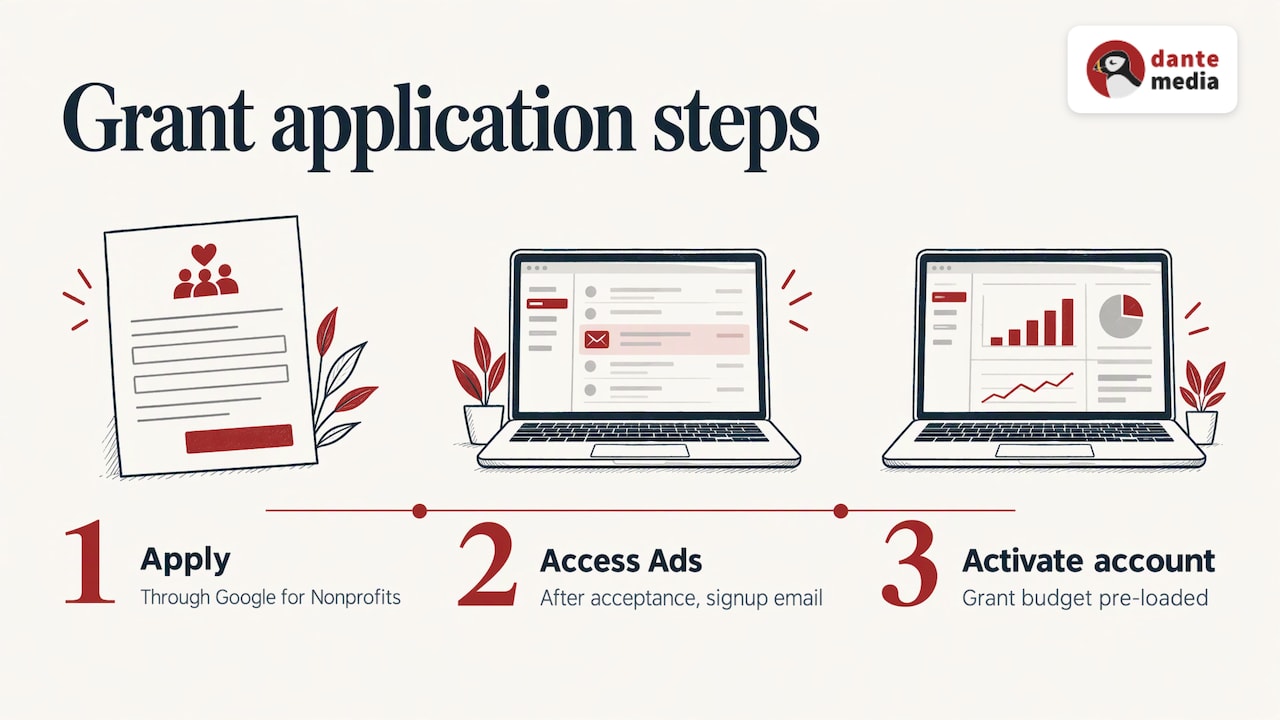
To get started, apply through Google for Nonprofits. Once accepted, you reach the account in Google Ads with the email you used to sign up, and the grant budget is pre-loaded after activation.
Start with goals, not keywords
Before you open Google Ads, write down three things:
- The action. What do you want a stranger to do? Donate, volunteer, download a report, join a newsletter, attend an event.
- The audience. Who searches for help with the problem you solve? Beneficiaries, donors, volunteers and policymakers use different words.
- The page. Where does that person land, and does it make the action easy in under a minute?
This is where most accounts go wrong. Teams pick keywords about their organization’s name and general cause, get impressions without outcomes, and conclude the grant “doesn’t work”. The grant works for specific intent: someone searching for what you offer, at the moment they need it.
Structure campaigns around your mission priorities
Google itself recommends separating important topics into campaigns rather than running one generic campaign. Its own example splits a literacy charity into books for babies, preschoolers, teens, volunteering and donations.
A simple structure for most organizations:
| Campaign | Audience | Landing page | Conversion |
|---|---|---|---|
| Services or support | People who need help | Service page | Contact or sign-up |
| Volunteering | Potential volunteers | Volunteer page | Application |
| Donations | Potential donors | Giving page | Donation |
| Awareness and advocacy | Informed citizens | Campaign or report page | Petition or newsletter |
Inside each campaign, cluster closely related keywords into themed ad groups so the ad matches the query. Split campaigns further when budget or priority differs.
Set geography honestly
Google requires specific targeting. Local services should target the relevant town or area, national or international campaigns should reflect where people can benefit, and different geographic services belong in separate campaigns. “Everywhere” is not a strategy and is not compliant.
Divide the budget on purpose
The monthly limit works out to approximately $329 USD per day, with local-currency conversion fluctuating. Divide it across campaigns by mission priority. Give your donor and volunteer campaigns room, but do not starve the support campaign that serves your core beneficiaries.
Keywords, ads and landing pages
Long-tail, intent-rich phrases beat broad ones. “Free legal advice for tenants in Chicago” will outperform “legal help” for a tenant-rights group, and it will qualify the visitor before they click.
For ads, Google recommends responsive search ads with multiple headlines and descriptions, short non-repetitive sentences, and language that explains your distinctive service or mission. Say what you do, for whom, and what the person should do next. Add the required two unique sitelinks and point each to a page with a real purpose.
Then look at the landing page as a stranger would. Does the headline repeat the promise of the ad? Is the action visible without scrolling? Does the page load fast on a phone? A fine ad sending people to a vague homepage is the most common leak we see.

The rules that shape your strategy
Compliance is not paperwork. It decides whether your account stays live. The account management policy sets out the main requirements:
- A 5% monthly account-level click-through rate for accounts not exclusively using Smart Campaigns.
- Conversion-based Smart Bidding in every campaign for accounts created on or after April 22, 2019, unless they use Smart Campaigns.
- Valid conversion tracking and at least one qualifying conversion per month for applicable accounts.
- Responses to periodic program surveys. Policy violations may lead to automatic suspension.
Also remember that strictly commercial advertising is not allowed: if you promote products or services, 100% of the proceeds must support the program. Google states this in its Australian program page, so confirm the wording for your own country.
The 5% CTR rule has a strategic consequence. Broad, vague keywords drag your average down. Tight themes and relevant ads keep it up, so good strategy and good compliance are the same work.
Measure what happens after the click
Google recommends tracking clicks and what users do after clicking, such as browsing, signing up for a newsletter or donating, to inform future fundraising. In practice:
- Link Google Analytics and Google Ads so Analytics key events can become Google Ads conversions for reporting and bidding.
- Keep conversion actions active and accurate. If tracking breaks, bidding and compliance both suffer.
- Review monthly: pause low-CTR keywords, rewrite weak ads, shift budget to the campaigns that convert.
- If the account is suspended, correct tracking, bidding or structure issues before requesting reinstatement.
A short monthly review beats a big annual rebuild. Put it in someone’s calendar and name the owner.
Our perspective
Most nonprofits we meet do not have a Google Ads problem. They have a story problem. The grant rewards clarity: a clear audience, a clear ask, a clear page. When an organization cannot say in one sentence who it helps and what it wants from a visitor, no bidding setting will rescue the account.
That is why we treat the grant as part of a wider communication strategy, not a standalone tactic. Search captures people who already care enough to look. Your brand, content, social channels and campaigns decide whether they find you credible when they arrive. Strong strategy, design and copywriting lift the results of every ad you run.
We built Dante to work only with organizations creating positive impact, and we are convinced that purpose-driven communication performs best when the strategy comes first and the channels follow. Free media is a gift. Let’s use it with intent.
Ali
Where we can help
If your team is stretched thin, the grant often becomes the task nobody has time for. We support impact-driven organizations with strategy consulting, brand work, content and campaigns, so that channels like Search connect to a clear story. Explore our impact campaigns or see the full range of communication services.
If your brand message is still fuzzy, start with brand strategy for impact. Clear positioning makes every ad sharper.
FAQ
Do we have to spend the full $10,000 each month?
No. Google says there is no requirement to spend the entire monthly budget. Spend what your strategy can use well, and expand as you add campaigns with clear goals and landing pages.
Can any nonprofit get Ad Grants?
Not every organization. You need to be a verified charitable nonprofit in a supported country and meet that country’s requirements. Governments, hospitals and schools are generally excluded, though some associated charitable arms may qualify.
How do we start using the grant after approval?
Sign in to Google Ads with the email you used for Google for Nonprofits, then build campaigns around your priorities. Set conversion tracking first, because most accounts must have it to stay compliant.
Why do accounts get suspended?
Usually because of policy issues: missed CTR, missing conversions, weak structure or unanswered surveys. Fix the cause, then request reinstatement, as Google’s policy describes.
Make the grant work for your mission
Pick one mission priority this week. Name the audience, write the ask, and build one campaign around it. Small, focused and measured beats big and vague every time. When you are ready to connect it to a bigger story, talk to us.
Sources
- Digital Marketing Program for Nonprofits - Google Ad Grants
- Ad Grant Requirements & Program FAQ’s - Google Ad Grants
- Eligibility guidelines - United States - Non-Profits Help
- Tips for success with Google Ad Grants
- Account management policy - Google for Nonprofits Help
- Understanding Budgets and Bidding
- Set up conversion tracking
Recommended


Let's talk
