Translation vs Transcreation: How to Choose the Right Approach

ÂLI OKUMUŞOĞLU
Translation carries information accurately from one language into another. Transcreation carries the effect of a message: its emotion, intent and style, rebuilt for a new culture. If your content must be precise (a grant agreement, a safety instruction), translate it. If it must move people (a campaign, a tagline, a fundraising appeal), transcreate it. The rest of this guide shows how to tell the two apart in practice, what each costs in time and effort, and how to set up a transcreation project so it works the first time.
TL;DR
- Translation prioritizes word- and sentence-level accuracy. Transcreation prioritizes reproducing emotional impact, intent and style in a new culture (Slator).
- Use translation for legal, official, technical and scientific content. Use transcreation when the goal is to persuade or provoke an emotional response.
- Transcreation starts from a creative brief, not just a source text, so the quality of your brief decides the quality of the result.
- It usually takes more research and time per word than translation, which is why it belongs on the content that carries your brand, not on everything.
- A sound process includes a cross-cultural audit, back-translations with rationales, and structured feedback rounds.
Table of Contents
- The difference in one paragraph
- Where the lines blur: translation, localization, copywriting and creative translation
- When to translate
- When to transcreate
- Is transcreation more expensive?
- How to build a transcreation strategy
- Where this goes wrong
- Our perspective
- Working with us
- FAQ
- Sources
The difference in one paragraph
Think of the source text as a means rather than an end. A translator’s job is to stay faithful to it: the same facts, the same structure, the same meaning. A transcreator’s job is to stay faithful to what the text was trying to do. If a slogan relies on a pun, a rhythm or a cultural reference that does not exist in the target language, a faithful translation gives you a correct sentence that does nothing. Transcreation gives you a different sentence that does the same thing.
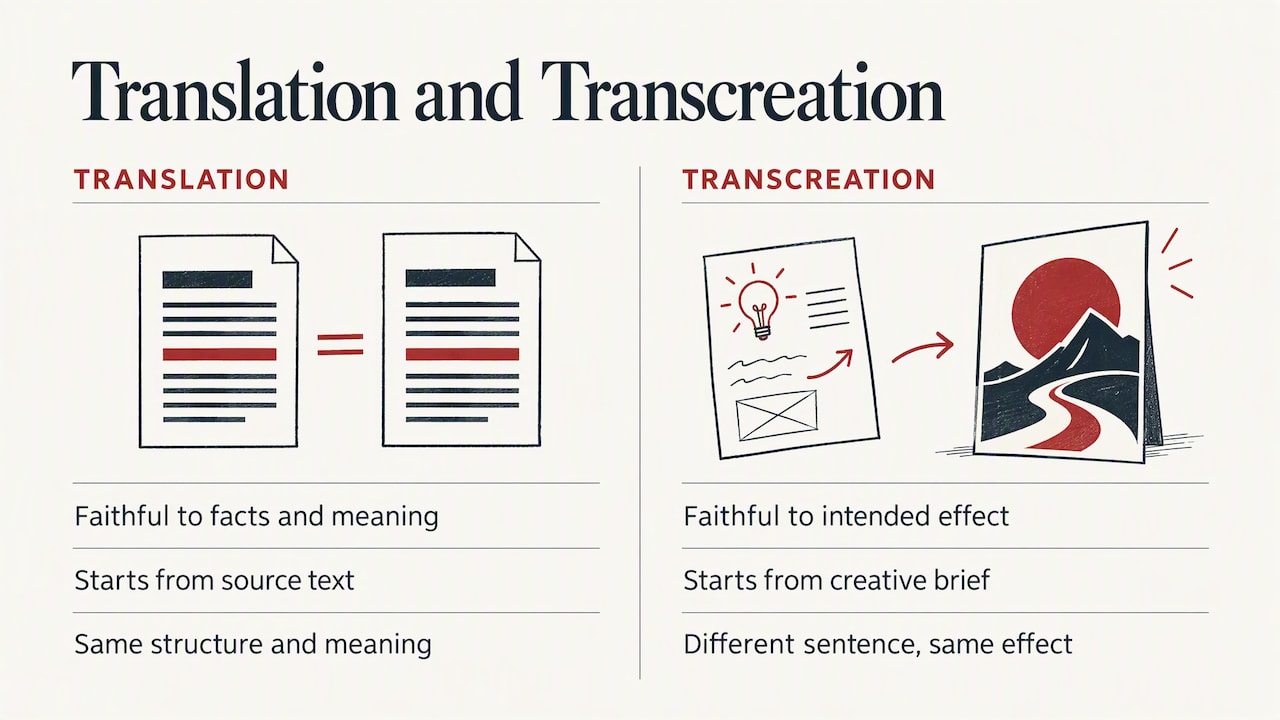
That is why the two disciplines start from different places. Translation starts with a source text. Transcreation projects often start from a creative brief, the way any other creative project would. The deliverable can be hybrid, too: a transcreation project may include conventional translation, entirely new copy and adapted imagery in the same package, as the International Federation of Translators describes in its paper on translation, localization and transcreation.
Where the lines blur: translation, localization, copywriting and creative translation
Most confusion comes from neighboring terms. Here is how they sit relative to each other.
| Approach | Starts from | Main goal | Typical content |
|---|---|---|---|
| Translation | An existing source text | Accurate meaning, sentence by sentence | Contracts, manuals, reports, scientific papers |
| Localization | A finished product or content set | Fit for a specific region: currencies, dates, units, interfaces | Software, websites, apps |
| Creative translation | A source text, with more freedom | Reworked ideas without full artistic license | Blog posts, brand storytelling, web copy |
| Transcreation | A creative brief and a source concept | Same emotional impact in a new culture | Slogans, campaigns, ads, appeals |
| Copywriting | A brief, no source text | Original content from scratch | Any new marketing copy |
A few points worth separating.
Localization adapts content for specific regions, including functional elements such as currencies, dates, measurement units and software interfaces, according to the Chartered Institute of Linguists. Academic work also notes that localization is mostly associated with the technical adaptation of software and platforms, while transcreation is mostly applied to marketing and creative campaigns (Babić, citing Pedersen). In a US setting, think of changing a date format and a price; that is localization. Rebuilding a joke that only works in French is transcreation.
Copywriting differs from transcreation because it creates original content with no existing source text (Babić). A transcreator has a source idea to honor. A copywriter does not.
Creative translation is the middle ground. It gives the linguist more freedom to rework ideas, without the full license of transcreation (Slator). For many organizations this is the practical sweet spot for long-form brand content.
One caveat on vocabulary. The professional world does not agree on every boundary. The International Federation of Translators treats translation as a broad cover term that includes conventional translation, localization and transcreation (Elbaz, 2021). So when you brief a vendor, describe the outcome you need rather than relying on the label alone.
When to translate
Choose translation when precision matters more than persuasion. The Chartered Institute of Linguists points to legal and official documents, technical instructions, and academic and scientific writing as the places where translation is particularly important.
For mission-driven organizations, that typically means:
- Grant agreements, contracts and compliance documents
- Terms of participation, privacy notices and safeguarding policies
- Technical annexes, methodology notes and research papers
- Funding reports and formal deliverables for consortia and public bodies
In these documents, creativity is a risk. A reader should be able to trust that every clause means what the original says. Hire a translator with subject expertise and, for anything with legal weight, a second reviewer.
When to transcreate
Choose transcreation when the primary goal is to drive an emotional response or persuade an audience through creative branding or marketing (CIOL). The test is simple: if the best version of this text depends on how it feels, a literal rendering will underperform.
Typical candidates:
- Campaign taglines and calls to action
- Fundraising and donation appeals
- Brand names, slogans and verbal identity elements
- Video scripts, social copy and ad creative
- Launch announcements for a new market
A practical rule: if you would have a copywriter or creative director sign off the English version, you should have a transcreator or creative linguist sign off the other language versions. Translating a brand voice word for word usually flattens it. The voice you spent months defining is a set of choices about rhythm, register and attitude, and those choices rarely survive a literal crossing.
A quick decision test
Ask three questions about each piece of content:
- What happens if the reader misunderstands a detail? If the answer is legal or safety exposure, translate.
- What happens if the reader feels nothing? If the answer is a failed campaign or a lost donor, transcreate.
- Is there wordplay, humor, rhythm or a cultural reference? If yes, transcreate, whatever the document type.
Many pieces fall in between. A website, for instance, mixes legal footers (translate), product descriptions (creative translation) and the homepage headline (transcreate). Sorting content into those three tiers is the cheapest decision you can make in a multilingual project.
Is transcreation more expensive?
Usually, yes per word, and for understandable reasons. Transcreation generally needs more background research on the brand and the market than standard translation, which makes it more time-consuming per word (Slator). You are paying for options, rationale and iteration, not just output.
What tends to drive the effort:
- Depth of the brief. A clear brief shortens the process. A vague one multiplies feedback rounds.
- Number of markets. Each market is its own cultural reading, not a copy of the last one.
- Format. A six-word slogan can take longer than a 600-word page, because every word is carrying weight.
- Visuals. If imagery needs adapting alongside the copy, the project grows into a hybrid.
- Review structure. Back-translations and rationales add steps, and they also protect you.
The smart way to manage cost is not to avoid transcreation. It is to apply it where it creates value and use translation elsewhere. Put your budget behind the 10 to 20 percent of content that shapes how people see you.
How to build a transcreation strategy
An effective approach starts with a clear, detailed brief and professionals who have both linguistic and marketing expertise, as the Institute of Translation and Interpreting’s transcreation code of practice outlines. Translator and author Nina Sattler-Hovdar calls the comprehensive brief the cornerstone of successful transcreation, because it has to capture the creative concept and the emotional response you want (via Slator).
Here is a workable sequence for a communications team.
1. Sort your content into tiers
Map every asset to translate, creative translate or transcreate. Do this before you request quotes. It will change the scope, the vendor you need and the timeline.
2. Write the brief like a creative brief
Include:
- Audience: who they are in this market, not just their language
- Brand values and voice: with examples of copy that sounds right and copy that does not
- Desired emotional impact: what should the reader feel, and what should they do next?
- Constraints: character limits, legal wording that cannot change, imagery, channels, deadlines
- The original concept: why the English version works, so the transcreator can protect the idea rather than the words
These are the elements the professional guidance identifies as the backbone of a good brief (ITI).
3. Choose people with both skill sets
A fluent linguist with no marketing instinct will translate. A marketer with no target-language depth will guess. You need both in one person or in a tightly working pair. Ask for samples from comparable campaigns and for the process they follow.
4. Expect a defined process
The process described in the ITI code involves analyzing the brief, performing a cross-cultural audit, brainstorming options, providing back-translations and rationales, and running feedback rounds (ITI). If a provider skips these steps, you are buying a translation with a higher price tag.
5. Use the cross-cultural audit
A cross-cultural audit is a standard step meant to flag reputational risks and cultural elements that may fail in the target market (Mavis Ho, ITI). For organizations working on sensitive topics such as climate, migration, health or gender, this step is where you avoid the expensive mistakes.
6. Review with rationale, not instinct
You may not speak the target language, so you cannot judge the copy by ear. Ask for a back-translation and a short rationale for each option: what the line does, why it replaces the original, what it deliberately leaves out. Then test with a few people from the real audience before you commit media budget.
7. Build the guidelines into your brand system
The field is still professionalizing. TAUS has argued that formal best practices are essential to differentiate transcreation from other language services (TAUS, 2019). Inside your organization, the equivalent is a short transcreation guide: your messaging pillars, tone rules and no-go areas, so every market starts from the same foundation and still sounds local.
Where this goes wrong
Three patterns come up again and again.
Translating the slogan last. The English campaign is finished, approved and filmed, and only then does someone ask how it will work in German or Arabic. By then, the idea is locked to a language-specific pun. Involve the transcreation lead while the concept is still open.
Treating one market as many. Spanish for Spain, Mexico and the United States are three different audiences. Decide which you are writing for.
Skipping the brief because the source text exists. The text tells a linguist what you said. Only the brief tells them why. Messaging that is vague at home will be vague everywhere, a problem we explore in three messaging mistakes to avoid with your brand.
Our perspective
Most of the organizations we work with are not selling a product. They are asking people to care, to join, to give, to change what they do. That is exactly the kind of message that does not survive a literal translation.
We see transcreation as a strategy question before it is a language question. If your brand does not know what it stands for, what it wants a reader to feel and what it wants them to do next, no linguist can carry that across a border. The strongest multilingual work we have seen starts at home, with a clear story and a clear voice, which is why we approach brand and campaigns together. Storytelling is the foundation, and translation is one of the ways it travels.
For EU-funded projects, consortia and international programs, the pressure is real: many languages, many stakeholders, limited time. Our advice is to be selective. Translate what must be exact. Transcreate what must move people. Put real thought into the brief, and give your language partners the same context you would give your own creative team.
Ambition without clarity is expensive. Clarity, with a bit of courage, travels well.
Ali
Working with us
If you are preparing a multi-market campaign, a launch or a consortium dissemination plan, the work that decides success happens before any translation: positioning, messaging and a brief your language partners can use. That is where we help. Our Campaigns for Change work plans and delivers purpose-driven, cross-channel campaigns, and Brand for Impact builds the strategy and verbal identity that make every language version sound like you.
See how we approached a complex, multi-channel challenge in our cross-channel storytelling case study, or talk to us about your next campaign.
FAQ
What is the difference between translation and transcreation?
Translation focuses on accuracy at the word and sentence level so the information is the same in both languages. Transcreation is a creative process that reproduces the emotional impact, intent and style of the original message for a new culture (Slator). The output can differ substantially from the source wording.
What differentiates transcreation from copywriting?
Copywriting creates original content from scratch, with no existing source text (Babić). Transcreation begins with an existing message and recreates its effect in another language and culture. In practice, the skills overlap, which is why good transcreators usually have a marketing or creative background.
Is transcreation more expensive than translation?
Typically, yes per word. It requires more research into the brand and market, and so takes more time per word than standard translation (Slator). Because of this, most organizations reserve it for high-impact content and translate the rest.
Is localization the same as transcreation?
No. Localization adapts content to a region, including currencies, dates, units and software interfaces (CIOL). Transcreation recreates a creative message so it has the same emotional effect. A project can need both.
How do I know whether a transcreation actually works?
Ask for back-translations and a rationale for each option, run feedback rounds, and check the copy with people from the target audience. A cross-cultural audit before launch also helps surface risks you cannot see yourself (ITI).
Sources
- Slator: What Is the Difference Between Translation and Transcreation?
- Chartered Institute of Linguists: Translation, localisation or transcreation?
- International Federation of Translators: Translation, Localization, and Transcreation
- Babić: Translator’s Role in Advertising, Transcreation as a Creative Process
- Institute of Translation and Interpreting: Transcreation Code of Practice
- TAUS: Transcreation Best Practices and Guidelines
Recommended


Let's talk
